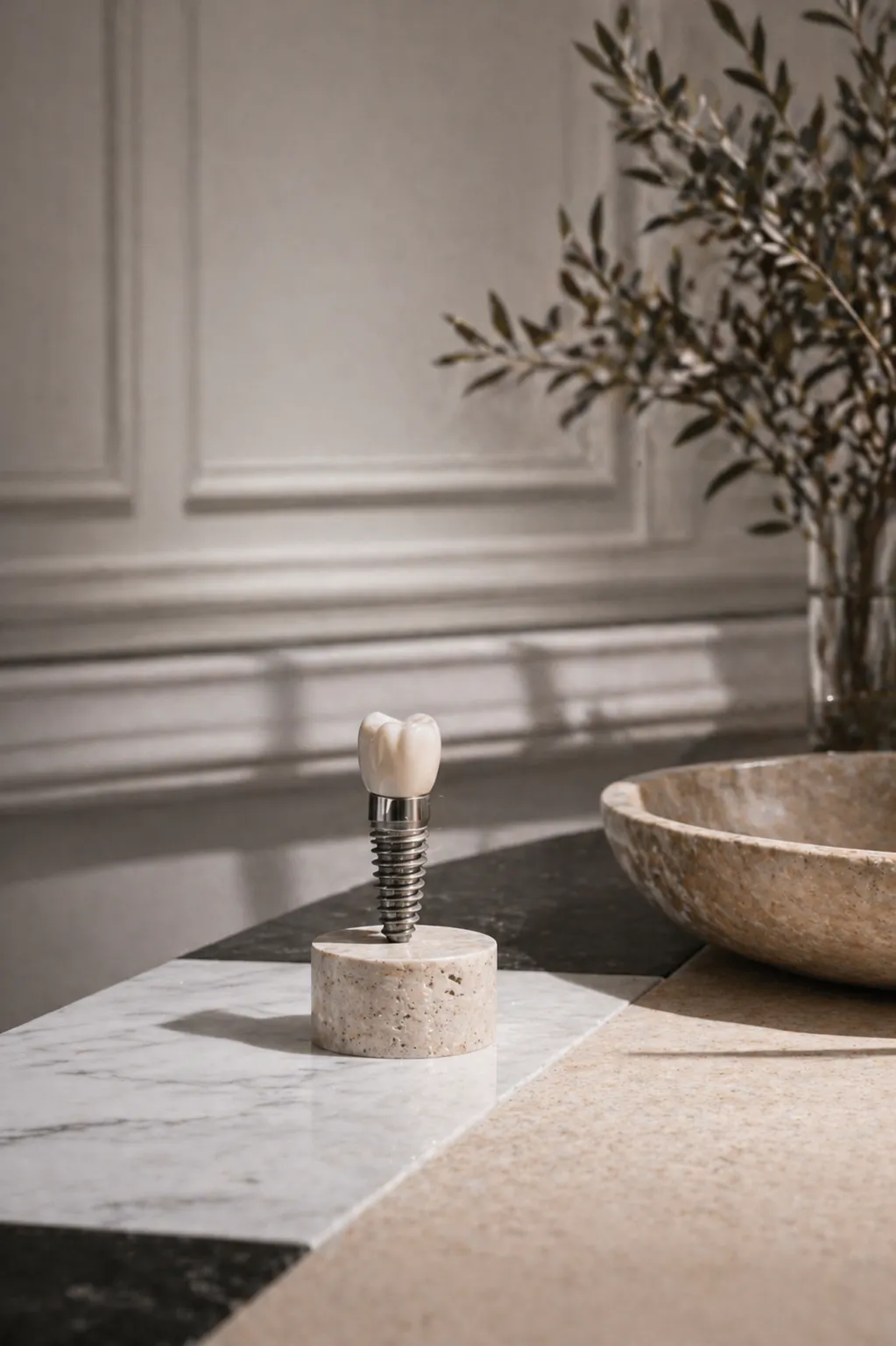
Dental implants: implant with ceramic crown on a pale stone base

Zaritzki Dental Implants

An implant does not simply replace a missing tooth. It replaces stability, function, aesthetics, and the things you never think about: chewing, speaking, smiling. At Zaritzki Fine Dentistry, implantology therefore does not begin with the procedure. It begins with the finished tooth: its form, its position, the line of the gum, the bite contacts, the way it acts in the face. Only from that does the ideal implant position follow. 3D diagnostics, navigated surgery and magnified work carry that planning into the mouth, depending on the starting situation under 5× loupes with LED light or under the surgical microscope at up to 25× magnification. Not as a technical effect, but as the consequence of a standard: the aim is not an implant that appears to sit correctly. It is a tooth that looks as though it had never been missing.

"Implants planned the way architecture is planned."

Archway view into the treatment room, fireplace and checkerboard marble in the foreground, Zaritzki Fine Dentistry on Kurfürstendamm

The Zaritzki Difference

Your treatment does not begin with the question of where an implant can be placed. It begins with how your new tooth should look, feel and function. The crown is planned from the start: form, position, the line of the gum, bite contacts, the effect in the face. The implant position follows from that. Not the other way round.

EXACT DIAGNOSTICS AND PLANNING
Bone, tissue and the course of the nerves are recorded three-dimensionally before the procedure, not estimated from the flat surface of an X-ray. Position, depth, axis and loading are settled before treatment begins, and the later crown is part of that planning from the start, not afterwards.

PRECISION THROUGH 3D-NAVIGATED SURGERY AND SIGHT
An individually made surgical guide transfers the plan into the mouth to the millimeter. Controlled, not freehand. The work is done under 5× loupes or the surgical microscope, so that the finest structures are seen exactly.

MATERIAL
We work with selected implant systems (Nobel Biocare, Straumann, Camlog, Astra), chosen individually according to biology, function and aesthetics. Where it makes sense over the long term, we assess biological support such as PRGF®, bone augmentation or a sinus lift.

THOUGHT THROUGH TO THE RESTORATION
The implant is not considered in isolation but planned as part of the bite, the aesthetics and the natural function. The result should not look like a successful replacement. It should look like a tooth that simply belongs.

Fireplace with books and flowers in the salon, Zaritzki Fine Dentistry, Berlin

Your Benefits

  • Precision you can feel. Aesthetics that fit in organically.
  • Planned as far as the crown. The finished tooth is settled before the implant is placed.
  • Thought from the face. The visible crown leads. The bone follows.
  • Neighboring teeth stay untouched. What is healthy stays. Unlike under a bridge.
  • As firm as your own tooth. Chewing, speaking, smiling. Without a thought.
  • The bone stays. A loaded implant preserves the jaw, where a gap lets it dwindle.
  • The difficult cases too. Immediate placement, sinus lift, bone augmentation. In our own house.
Treatment room with ceiling screen and pale leather treatment chair

The Zaritzki Experience

  • You are not kept waiting. You are expected.
  • Water in crystal. Coffee in French porcelain.
  • Your preferences, chosen on the tablet.
  • Your film, your series, on the ceiling, with language, volume and subtitles as you prefer them.
  • Noise-cancelling headphones, so the rest disappears.
  • In the background, everything is already prepared.
  • The anesthesia is given carefully and in two stages: a pre-anesthetic for the injection, a local anesthetic for the treatment.
  • For patients who are particularly tense, nitrous oxide is available: gentle and controllable.

"Micrometers decide. So we leave none of them to chance."

Panoramic X-ray to assess bone and implant position

Who is a Zaritzki dental implant for?

An implant is the right solution for patients who:

  • do not want a provisional solution but a permanent one
  • want a restoration as stable as a natural tooth
  • want to keep their healthy neighboring teeth without reducing them for a bridge
  • want function, aesthetics and everyday comfort together
  • expect their practice to solve difficult cases reliably as well

    Requirements: healthy gums and completed bone growth. Where bone is missing, the foundation can in many cases be built up.

Dental implants in Berlin: treatment under dental loupes

How a Zaritzki 3D implant placement works

1. Health Check

We examine the health of your teeth, your gums and your jaw, to secure the conditions for your implant. Photographs and video record the starting situation and enter the aesthetic planning.

2. Precise 3D diagnostics and planning

A 3D scan and digital X-rays provide data accurate to the millimeter, for exact planning of implant position, depth and crown. The whole treatment is settled before the first step is taken: controlled and precise, not freehand.

3. Minimally invasive, 3D-navigated placement

The placement is minimally invasive, under local anesthesia or sedation (nitrous oxide, for example), or under general anesthesia if you prefer. With a custom 3D surgical guide and a virtual simulation of the procedure, the implant is placed exactly as planned. A final quality check confirms that it is firm. In many cases the crown can be attached shortly after the procedure, and in suitable situations immediately.

4. Healing phase

During integration we accompany you closely. Regular review appointments secure the course, while the implant grows firmly together with the jaw.

PRGF®: support for healing
The PRGF® procedure uses your own blood plasma, rich in growth factors, to support tissue regeneration and reduce post-operative symptoms such as swelling. A procedure using the body's own material, which is as a rule well tolerated.

Consultation room with marble table for 3D implant planning

FAQ – Your questions about Zaritzki dental implants

What advantages do dental implants offer?
  • Gaps closed invisibly, with natural aesthetics and function.
  • An implant looks and feels like your own tooth.
  • Unrestricted chewing and biting.
  • Clear, natural speech.
  • Preservation of the jawbone, where a gap leads to bone loss.
  • Stable facial structures instead of collapsed contours.
  • Protection of the neighboring teeth: healthy teeth stay untouched.
  • A permanent solution, with good care.
How safe is a 3D-navigated implant placement?

Guided, 3D-navigated placement is considered the gold standard of modern implantology. Precise planning, controlled execution and the experience of a specialized team create the conditions for a result that is stable over the long term. We follow the course with regular review appointments and document it traceably.

How are anxious patients treated?

The wellbeing of anxious patients matters to us particularly. We take account of your individual needs and make the time before, during and after the procedure as pleasant as possible. Where it helps, sedation with nitrous oxide or treatment under general anesthesia is available: calm, controlled and matched to you.

Which materials does Zaritzki Fine Dentistry use?

We use exclusively premium implants from the leading manufacturers Nobel Biocare, Straumann, Camlog and Astra. For each case we determine type, diameter and length individually, matched to the anatomical conditions. Good bone quality makes the treatment easier; what is decisive for a stable result beyond that is precise planning and controlled execution.

Are there allergies or intolerances to implants?

Allergies to titanium are extremely rare. Modern implants have bioactive surfaces that support integration. For patients who prefer a metal-free solution, we offer zirconia ceramic implants: biocompatible, with natural aesthetics.

How long do dental implants last?

With professional treatment and good care, implants can last a very long time. What is decisive is regular cleaning, as with natural teeth, and professional follow-up. Our review appointments and dedicated implant hygiene sessions support function, comfort and aesthetics permanently.

Can I have an implant if bone is missing?

Yes. Where bone is missing, it can in many cases be rebuilt, to give the implant a secure hold. Several procedures are available, from bone substitute material and the body's own bone to bone splitting or a sinus lift.

Why should a gap be closed with an implant as soon as possible?

After a tooth is lost, the jawbone recedes at that place. An implant loads the bone like a natural root and so preserves the stability of the jaw. If the gap is left unrestored for a long time, bone loss can progress so far that additional augmentation becomes necessary before placement.

Is the placement painful?

No. With the anesthesia available, from local anesthetic to general anesthesia, the procedure can be made largely free of pain.

How much pain is there after a placement?

After an uncomplicated placement, only slight discomfort is usually to be expected, and mild pain medication is often enough. With larger procedures involving bone augmentation, matched medication provides a calm healing with little pain.

Up to what age can implants be placed?

As a rule there is no upper age limit. Bone keeps its capacity to regenerate into advanced age, so that an implant can integrate securely then too. What is decisive is not age but general health.

When does a placement take place?

The timing depends on your individual situation. Two typical scenarios:

Immediate placement after extraction
Where a tooth cannot be kept, we remove it gently and preserve as much bone and gum as possible. 3D diagnostics establish whether direct placement is possible. If it is, we place the implant immediately, in suitable cases with a crown that can be screwed on shortly afterwards. This demanding technique requires exact planning, modern technology and experience.

Classical placement in an existing gap
Where the gap already exists, a 3D image shows whether enough bone is present. With sufficient bone quality we begin with planning and 3D-navigated placement. Immediate loading is often possible here too, so that implant and crown are placed in the same session. This shortens the healing time to about three months.

When is the crown attached to the implant?

Three to six months of waiting used to be usual before the crown could be placed. Today that integration time can often be shortened considerably. In the visible area in particular, the implant can in suitable cases be restored with the crown immediately (immediate loading), so a longer provisional phase is not needed.

How is the crown attached to the implant?

We use screw retention, the gold standard for implant crowns. The crown is screwed firmly to the implant through the abutment, which allows clean integration and high functionality. With screw-retained crowns the risk of inflammation and bone loss is lower than with cemented ones.

A further advantage: the crown can be removed and replaced when needed, without being damaged.

What is bone augmentation?

After a long period without a tooth, or with pre-existing bone loss, there can be too little bone in the jaw for an implant. With cone beam computed tomography (CBCT) we analyze the bone structure precisely. Even with advanced loss, placement is often possible, because the bone can be rebuilt, in some cases even in the same session as the placement. Depending on method and extent, the integration time is about two to six months.

How is bone augmentation carried out?

Where there is too little jawbone, we use bone substitute material. After a small incision it is positioned precisely and protected with a biologically degradable membrane. The body then converts it into its own bone.

In suitable cases the augmentation can be combined directly with the placement; the integration time is then about two to six months. In the posterior upper jaw a sinus lift is often required, to raise the sinus and create sufficient bone volume.

What is an internal sinus lift?

An internal sinus lift is used when only two to three millimeters of bone height have to be added in the upper jaw. The minimally invasive procedure takes place in the same session as the placement: bone substitute material is introduced through the slightly raised sinus floor before the implant is placed. The area is then closed without tension, and no additional integration time is required. This allows fast, controlled treatment where bone height in the upper jaw is low.

What is an external sinus lift?

An external sinus lift is used when more than three millimeters of bone height are needed to anchor an implant stably. The gum is opened on the outer side and a small window in the bone is created, in order to raise the sinus floor carefully without injuring the membrane. The resulting cavity is filled with bone substitute material.

Once a bone height of three to five millimeters is reached, the implant can be placed in the same session. In more pronounced cases the placement follows after an integration period of about three months.

Your own bone or bone substitute material?

Sufficient bone volume is decisive for the long-term hold of an implant. Where possible we use the body's own bone from the oral cavity. Where that is not enough, tested bone substitute materials are used, developed for a stable, permanent anchorage.

We work with established materials such as Bio-Oss®, Puros® Allograft, CERASORB® and Straumann® Emdogain®. They convert reliably into the body's own bone and create the basis for a result that is stable over the long term.

What are the advantages of the PRGF® procedure?
  • PRGF® uses your own blood plasma, rich in growth factors, to support healing after implant placement.
  • The Benefits
  • Support for tissue and bone regeneration around the implant
  • Reduction of post-operative symptoms such as swelling
  • Faster wound healing
  • A procedure using the body's own material, which is generally well tolerated

The Zaritzki Standard

  • Implantology expertise, published in leading specialist journals
  • Implantologists, prosthodontists and functional specialists in one team
  • 3D diagnostics and fully navigated planning, not freehand placement
  • Microsurgical precision under magnification
  • PRGF® to support tissue and bone regeneration
  • Premium implant systems: Nobel Biocare, Straumann, Camlog, Astra
  • Experience in complex cases: immediate placement, sinus lift, bone augmentation
  • Technical equipment at the international top level
  • Results with documented long-term stability
Salon with bouclé sofas, bay windows and a Murano glass chandelier, Zaritzki Fine Dentistry on Kurfürstendamm

Pain

A comfortable treatment through advanced anesthesia techniques. PRGF® supports the healing.

How long the results last

Long-lasting, with good care and regular follow-up.

Price

Billed in accordance with the German dental fee schedule (GOZ), with a transparent cost estimate after the consultation.

During the treatment

  • Entertainment
    Your series, your film on the ceiling display, noise-cancelling headphones. You lose your sense of time. Not your sense of control.
  • Comfort
    A spa lounger, quiet sound, the faintest trace of scent, and a room that shuts out everything except the result.
  • Service
    The team is there before you ask. Greeted by name, your coat taken, everything ready. Attention you never have to request.