Fine Dentistry
Bruxism. When the bite sinks, the face sinks with it.
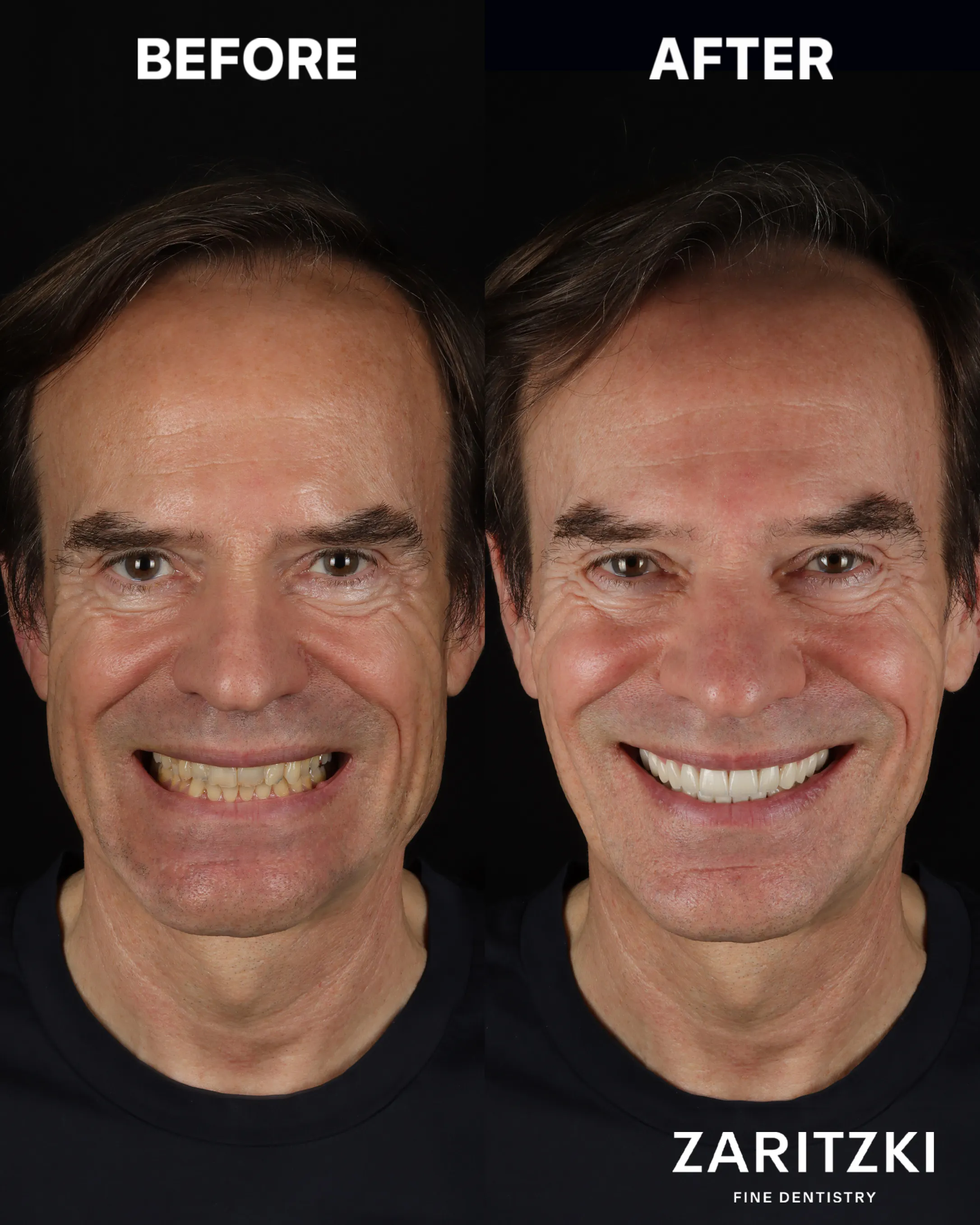
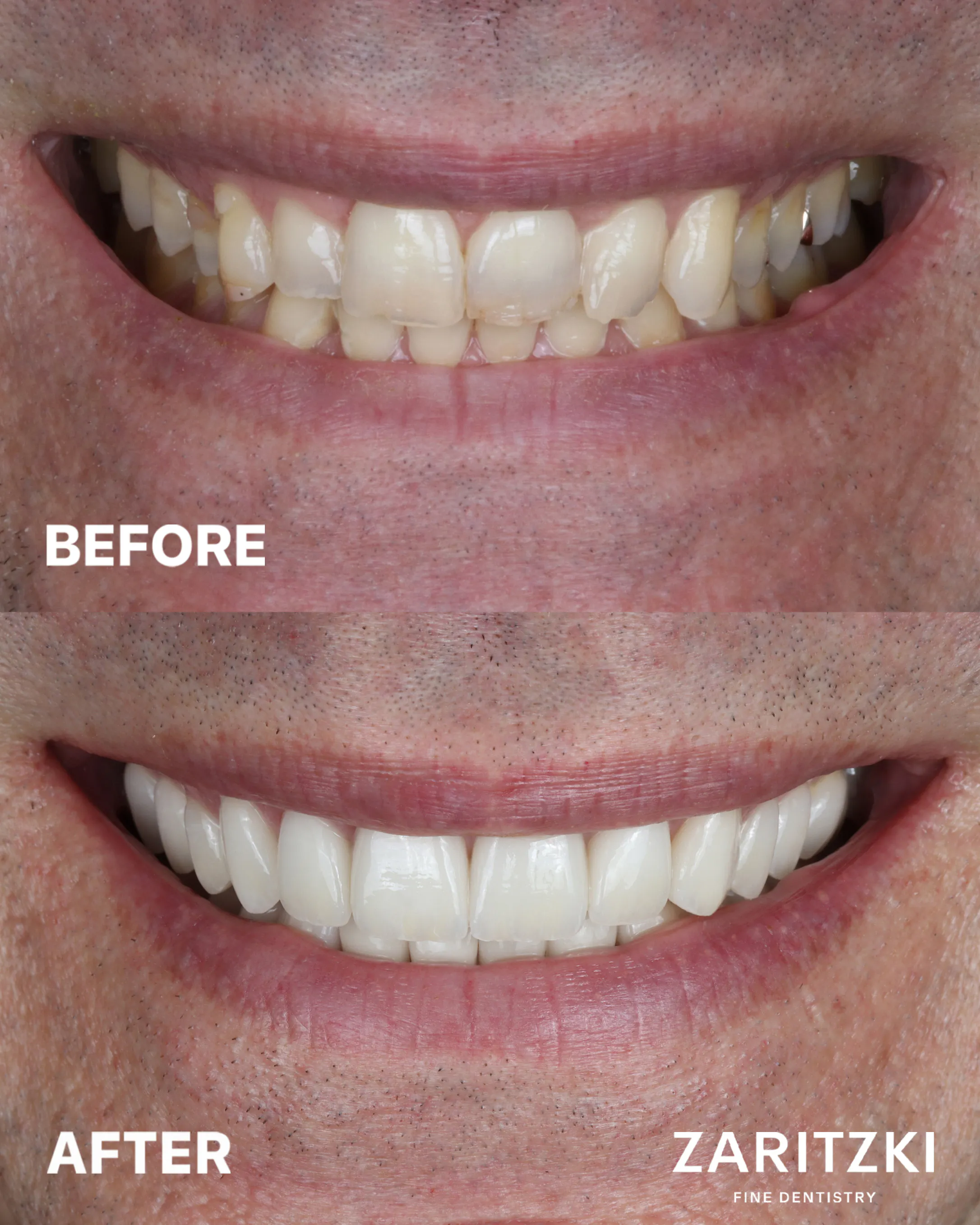
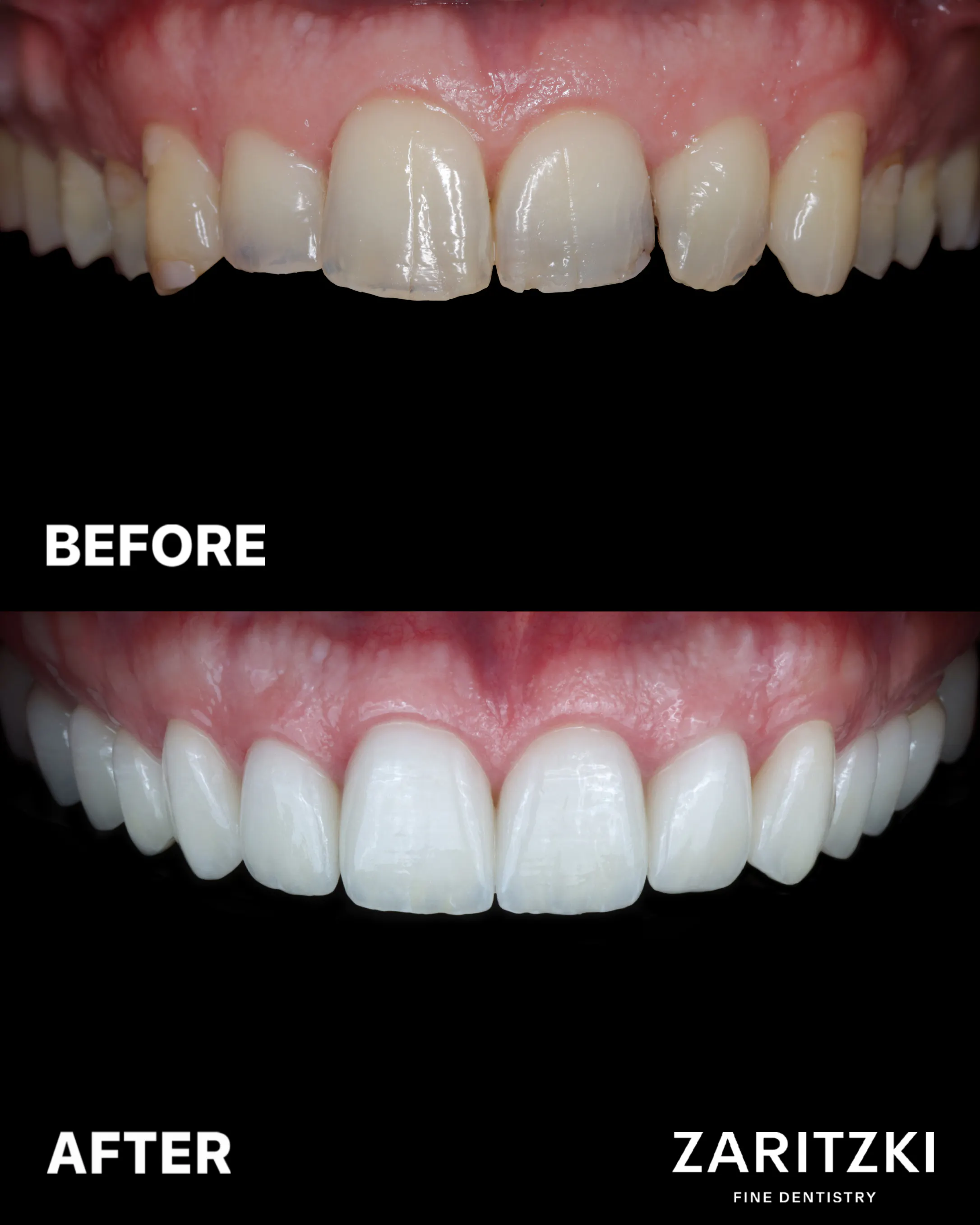
Teeth don't get shorter overnight. They get shorter over years. He came because of the pain: his jaw joints, his chewing muscles. The rest he only saw in the images. Years of grinding and clenching had worn away much of his tooth structure and let his bite collapse. With it, the lower third of his face had lost its natural height. No one could say why.
Diagnosis
Generalized tooth wear with pronounced sensitivity, inadequate previous restorations, significantly reduced vertical dimension with functional impairment.
The Decision
Raising the bite is a step many dentists shy away from. Choose the wrong vertical dimension, and correcting it later is a major undertaking. So here, the new height wasn't set. It was tested. It was determined, simulated, trialled on a splint in the position his chewing muscles find naturally at rest, and then worn in everyday life, long before a single definitive restoration was made. Only once the height had proven itself in his life was it built.
Goal
A stable bite and the lost height regained, and with it the natural height of the lower third of his face. Plus clearer tooth shapes and a naturally brighter shade.
Our Approach
- Analysis: Bite, jaw joints, chewing muscles. Photo and video analysis, digital scan.
- The Facial Aesthetic Concept©: Facial architecture, smile line, proportions. The goal was defined in the face, and function was built to match.
- Real Face Preview: He saw the result before anything had begun.
- Function, the new bite height: Determined and simulated. Measured, not estimated.
- Test Drive: Prototypes worn in everyday life: eating, speaking, laughing. Only then was the height final.
- Final reconstruction: Veneers and ceramic restorations in the tested bite position, as minimally invasive as possible.
Result
The bite holds again. The discomfort in his jaw joints and chewing muscles has eased. The lower third of his face has its height back: visible, yet no one could say why. What stands out isn't the work. It's the face in front of it.
Treatment Time
Three weeks for the definitive reconstruction, once the Test Drive was complete.



1/5
Please note
The treatment shown is an individual case. Treatment plans and results vary depending on the initial findings.
What are Zaritzki Restorations?
It should be perfect, but it shouldn't look perfect. That is the hardest brief in dentistry, and it comes down to three things.
No one should see it. A restoration must never look more regular than the rest of your teeth. Light, surface and translucency are matched to what is already there, not to an ideal. A tooth has texture, tiny irregularities, its own way of breaking light. That is exactly what is recreated. This is why the ceramic is handcrafted in a master laboratory, and why the shade is refined in a try-in before anything is permanently placed.
It should feel exactly as before. Your tongue knows every millimeter of your mouth and finds every edge. Contact points, bite guidance and transitions are therefore shaped so that nothing new feels new. The spaces between your teeth stay as you know them, and floss should glide as it always has.
As little as possible should be taken away. We fight for every millimeter of your natural tooth. Every tooth raises the same question: how much is necessary, and how little is enough? An inlay, for as long as an inlay will hold. A partial crown when the chewing surface is lost. A full crown only when the tooth needs protection all around. We work with 5× magnification loupes and specialized LED light, with instruments made for this standard, and with the time it takes. Preserving tooth structure takes longer than removing it. That is why it takes longer here.
And because a restoration must fit not only the tooth but the face, it begins with The Facial Aesthetic Concept©: the aesthetic goal is defined first, and bite guidance and load are built around it. What remains is the impression that nothing was done, only that everything is right.

What made Dr. Felix Zaritzki a specialist?
The first thing Dr. Felix Zaritzki looks at in a new patient is the face in motion: how they speak, how far the lip lifts when they laugh, how much tooth shows. That is where he decides what a smile should look like. He has been a dentist since 1999, and after several thousand veneers, that decision has become his signature.
From it grew a method that breaks with a rule. In German dentistry, the order has always been function first, then aesthetics. He reversed it. First, the aesthetics are defined: the length, width, proportion and shade of every tooth, attuned to facial architecture and smile line. Then the form is built to match, and with it the function. Bite height, contacts and guidance are measured, simulated and tested until they carry the defined image exactly. The aesthetics set the goal, and the data aligns every millimeter to it.
His patients from Germany and abroad see their result before it exists: in the Real Face Preview, in their own mouth, and in the Test Drive, in their own everyday life. Only what has proven itself there is made in ceramic.
In the profession, this method is known as The Facial Aesthetic Concept©. It was published as the lead article in cd cosmetic dentistry. The spaces he works in follow the same standard: his practice at Gendarmenmarkt was the first dental practice featured in Architectural Digest Germany.