Fine Dentistry
Orthodontic treatment in adolescence. Corrected only decades later.
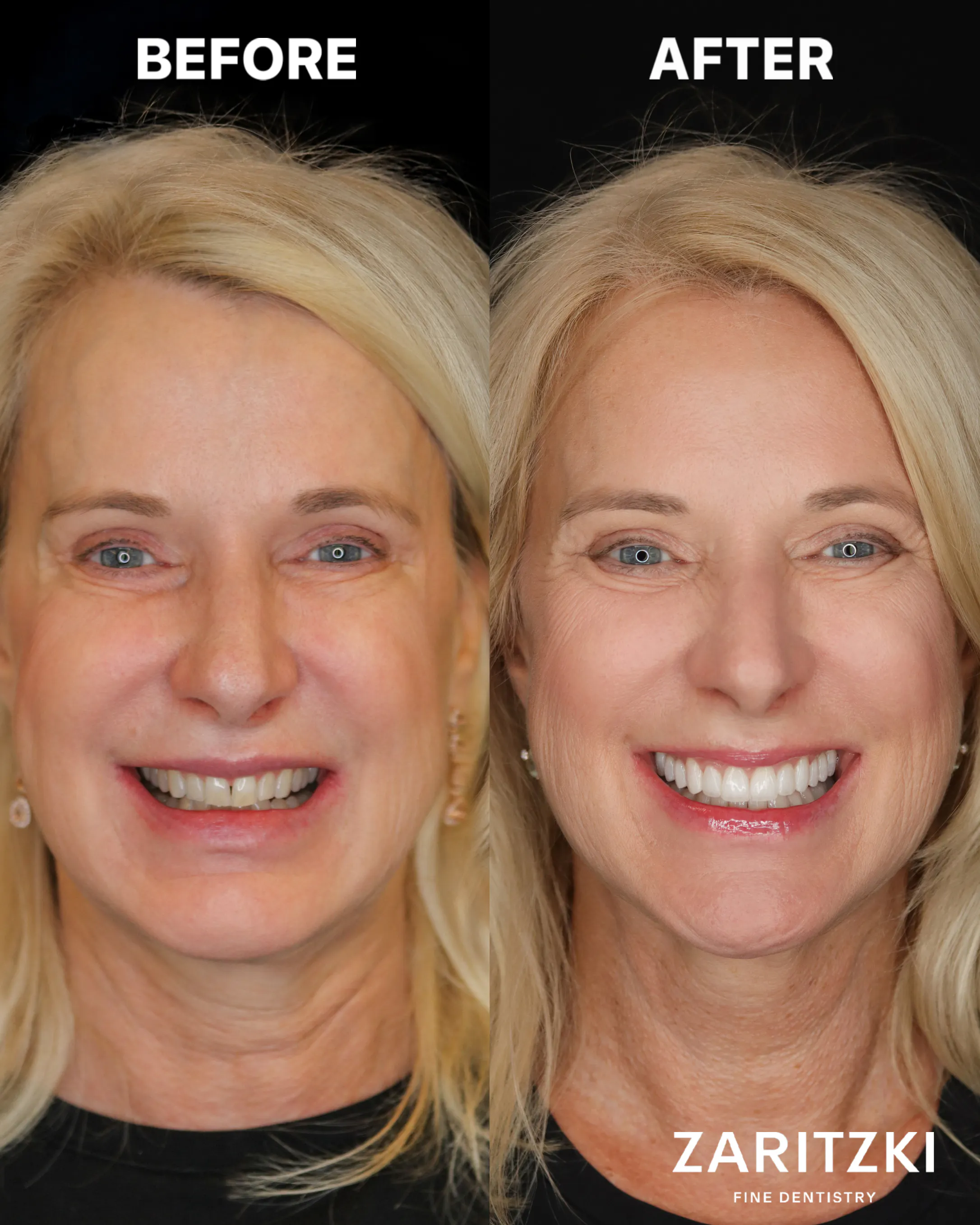
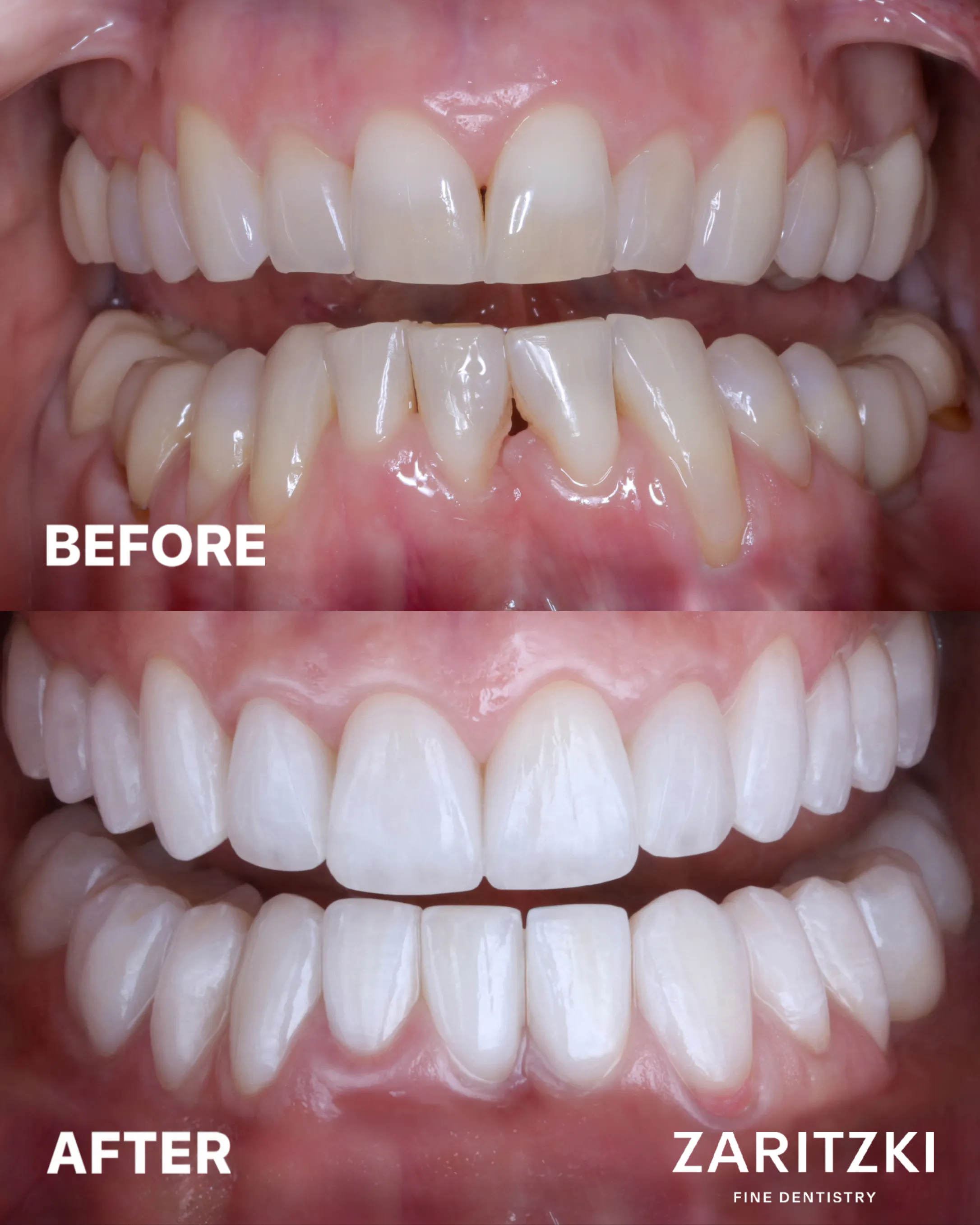
As a teenager, she had severe crowding. At the time, it was recommended to remove one of her lower front teeth, a decision that would shape the rest of her life. The resulting gap was closed orthodontically, which meant the remaining teeth had to be moved and tilted considerably. What seemed finished back then continued to have an effect for decades. The tooth axes became increasingly uneven, the gums receded, the bite height dropped and the teeth ground against each other, causing wear. On top of this came problems with the chewing muscles and jaw joints. The task, therefore, was not to make a small correction to the old tooth position. The entire bite had to be replanned and rebuilt.
Diagnosis
Pronounced misalignment following earlier orthodontic treatment, significantly worn teeth and reduced bite height. In addition, receding gums, problems with the chewing muscles and jaw joints, and several older restorations that needed to be replaced.
The Decision
The complex initial findings and the treatments she had already undergone called for a clear overall plan: to reorganise aesthetics and function while preserving as much natural tooth structure as possible. First, The Facial Aesthetic Concept© was used to define the final aesthetic result: tooth shapes, proportions, visible tooth length and their effect within the face. Building on this, bite height and function were replanned. The teeth were then moved into a more favourable position with Invisalign. This made it possible to carry out the subsequent reconstruction with veneers and ceramic restorations in a far less invasive way. First the right position. Then the definitive form. This is how everything worth preserving was preserved.
Goal
The lost bite height needed to be rebuilt. At the same time, we wanted to prepare the teeth so that as little healthy tooth structure as possible would have to be removed for the later reconstruction.
That is why treatment began not with ceramics, but with Invisalign. Crooked or poorly positioned teeth were first moved into a better position, so they would not later need to be ground down further just to make veneers or other ceramic restorations fit properly. This is what a truly minimally invasive approach means: improve the position first, then remove tooth structure only where it is genuinely necessary. Aesthetically, the smile was to appear wider, lighter and more natural, with more visible tooth length, more harmonious tooth shapes and a naturally brighter shade. Function, tooth position and aesthetics were planned together from the very beginning.
Our Approach
- The Facial Aesthetic Concept©
First, the final aesthetic result was defined within the face: tooth lengths, proportions, smile line and the desired effect of the smile. - Replanning function
On this basis, bite height and lower jaw position were redefined and functionally aligned. - Invisalign before reconstruction
Tooth positions were corrected in a targeted way, so that the later veneers and ceramic restorations could be carried out far less invasively. - Medical stabilisation
Inflammatory findings were treated, three existing root canal treatments were redone and failing older restorations were replaced. - Implantology & implant prosthodontics
One new implant was placed, and two existing failing implant crowns were replaced and integrated into the overall plan. - Vertical Restore
The lost bite height was rebuilt and the upper and lower jaws were realigned with each other. - Test Drive
Tooth shapes, bite height, function and aesthetics were first worn in the mouth and tested under real conditions. - Fine-Tuning
Shape, length, tooth contacts and proportions were refined further while everything could still be changed. - Definitive reconstruction
The tested result was implemented with individually layered veneers in feldspathic ceramic and lithium disilicate, together with ceramic partial crowns, crowns and implant crowns.
Result
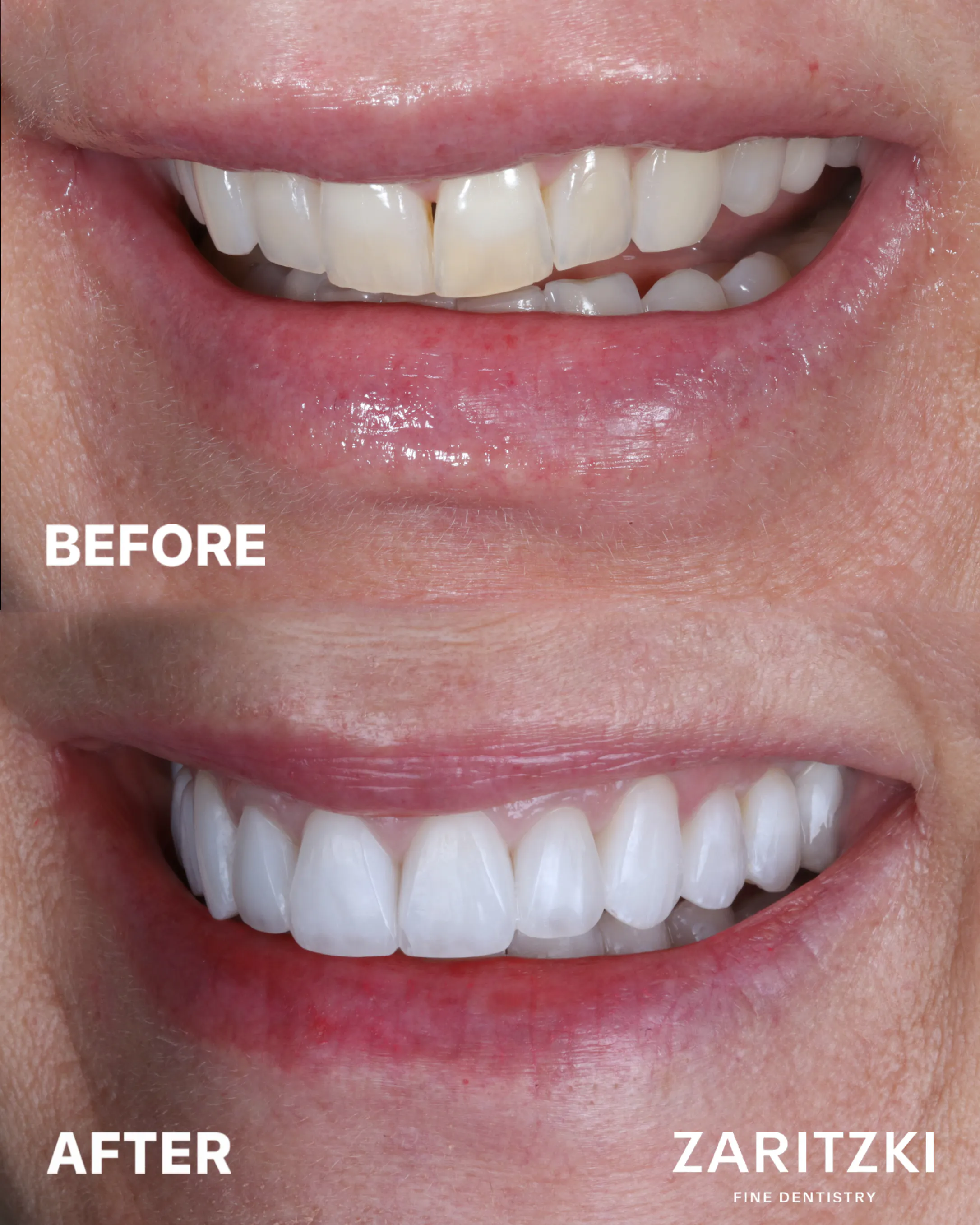
The lost bite height was rebuilt, tooth positions and contacts were realigned and the functional situation was stabilised. Inflammatory findings were treated, older failing restorations were replaced and the implant prosthodontics were integrated into the new overall plan.
Aesthetically, the smile now appears wider, lighter and calmer. The teeth show more length again, the axes look more harmonious, the proportions are clearer and the shade is naturally brighter. Despite the different types of restoration, the technical complexity remains invisible in the result. Many different treatments. One result that looks entirely natural.
Treatment Time
6 months, including orthodontic correction. A further four weeks for the definitive reconstruction, including the Test Drive.




1/6
Please Note
The treatment shown represents an individual case. Treatment plans and results vary depending on the initial findings.
What are Zaritzki Restorations?
Perfect is the goal. But it must not look perfect. That is the hardest brief in dentistry, and it is decided in three places.
No one should see it. A restoration must not be more regular than the rest of your teeth. Light, surface and translucency are modelled on what is already there, not on an ideal. A tooth has texture, tiny irregularities, its own way of refracting light. That is exactly what is recreated. This is why the ceramics are handmade in a master laboratory, and the shade is matched during a try-in before anything is permanently placed.
It should feel exactly as it did before. Your tongue knows every millimetre of your mouth and finds every edge. Contact points, bite guidance and transitions are therefore crafted so that nothing new feels new. The spaces between your teeth also stay the way you know them. Floss should glide through just as it always has.
Nothing should be taken away. We fight for every millimetre of your own tooth. Every tooth begins with the same question: how much is necessary, and how little is enough? An inlay, as long as an inlay will hold. A partial crown when the biting surface is lost. A crown only when the tooth needs protection all the way round. We work under magnifying loupes at five times magnification and special LED light, with instruments made for this scale, and with the time it takes. Preserving tooth structure takes longer than removing it. That is why it takes longer here.
And because a restoration must suit not only the tooth but the face, everything begins with The Facial Aesthetic Concept©: the aesthetic goal is defined first, and bite guidance and load are built around it. What remains is the impression that nothing was done. Only that everything is right.

How did Dr. Zaritzki become a specialist?
Dr. Felix Zaritzki has 27 years of experience in full-mouth transformations, that is, aesthetic and functional full-mouth rehabilitations. Over this time, he has placed thousands of veneers and non-prep veneers for discerning patients from Germany and abroad. International training and close exchange with renowned dentists and master dental laboratories around the world, combined with the development of his own treatment techniques, have shaped the aesthetic approach behind his reputation for veneers.